Saturday, September 26, 2015

Opening: PROSTHESES. Transhuman Life Forms

PROSTHESES. Transhuman Life Forms
Susanna Hertrich 


Photos from the opening - 25 September, 2015


Prostheses for Instincts

Jacobson's Fabulous Olfactometer (JFO)


Prostheses for Instincts


Thursday, September 24, 2015

PROSTHESES. Transhuman Life Forms// Susanna Hertrich / opening on 25 September, 2015


PROSTHESES. Transhuman Life Forms
Susanna Hertrich
Opening: 25 September, 2015 8PM
Panel discussion with Susanna Hertrich & guests: 6 November, 2015
Exhibition runs: 26 September – 29 November, 2015

The exhibition explores the phenomenon of the prosthesis as bodily extension in the 21st century. Exploring new technologies and recent developments in neuroscience and biology, Susanna Hertrich proposes new transhuman sensory extensions of what may eventually become 'human 2.0'. The exhibited works are part of her long-term artistic research project Bodies & Technology. In Susanna Hertrich's work a narration is constructed in which the human sensory apparatus is extended through computer controlled prostheses. The results can be understood as crossing the boundaries between artistic hypothesis and technological experimentation. The artworks reflect our current living environments, as well as critically question the social, political and physical consequences of the new technologies utilised in their making.?

The series Prostheses for Instincts explores the idea that by augmenting our natural sensory experiences we can widen the range of our perceptions. In doing so, Hertrich has created new mechanisms for surviving in a changing world. For example, Jacobson's Fabulous Olfactometer (JFO), a device worn on the head and face, is a sensorial prosthesis that mimics mammalian "flehmen response" when air pollution levels become too high. In short, when the device detects a dangerous level of pollution the prosthesis curls back the wearer's top lip, exposing her teeth, mimicking a reflex common, for instance, in horses or cats. The JFO simultaneously refers to a common, but often invisible 21st century threat and a biologically programmed reaction to danger in the animal world.

Next to Hertrich's works Art Laboratory Berlin will showcase a prize winning film on Neil Harbisson and the Cyborg Foundation by Rafel Duran.


More information at: http://artlaboratory-berlin.org/html/eng-exh-archive.htm

Monday, September 21, 2015

Theresa Schubert Artist Talk and Finissage

Theresa Schubert and Christian de Lutz


Thursday, September 17, 2015

Theresa Schubert Artist Talk and Finissage - Sunday September 20th at 15h

Finissage for the exhibition Growing Geometries - Evolving Forms. Theresa Schubert will be present to speak about her work.  Sunday, September 20th at 3pm.

Wednesday, September 02, 2015

Review of Growing Geometries - Evolving Forms

Theresa Schubert, bodymetries, interactive, generative installation (HD video and sound) 2013-14, copyright Theresa Schubert 

Art In Berlin has a great review of Theresa Schubert's exhibition:

http://www.art-in-berlin.de/incbmeld.php?id=3690

Opening - Growing Geometries - Evolving Forms - works by Theresa Schubert


Regine Rapp, Theresa Schubert, Christian de Lutz
Theresa Schubert, Growing Geometries (tattooing mushrooms), 2014-2015

Theresa Schubert, Growing Geometries (tattooing mushrooms), 2014-2015.  Photo: Theresa Schubert

Theresa Schubert, bodymetries, 2013-14.  A collaboration with Michael Markert and Moritz Dreßler.


Photo: Theresa Schubert


Thursday, August 27, 2015

Theresa Schubert // Growing Geometries - Evolving Forms

somnipherous observatory, interactive, generative installation (HD video and sound) 2013-14,  
Theresa Schubert // Growing Geometries - Evolving Forms
Exhibition runs: 29 August– 20 September, 2015
Opening: 28 August, 2015 8PM

Artist talk and Finissage: 20 September, 3PM

"In her experimental setups, Theresa Schubert condenses the most simple organisms to highly complex philosophical questions. In the artistic research project Growing Geometries I - tattooing mushrooms, fungi generate their growth by processing organic material. Together with the treatment of the mushroom with tattoo needles, their natural growth creates a closer proximity to that of mankind than to that of plants. A natural phenomenon is translated into a moment of critical analysis of processes of growth with the simplest of means. Theresa Schubert's tattooed mushroom are fruits of a deeper lying mesh whose growth can take any shape or form based on devitalized organic material causing revitalization." (Kerstin Godschalk, curator HB55 Kunstfabrik Berlin)

The exhibited works have been developed as part of her PhD research at the Bauhaus University Weimar. In the words of Theresa Schubert: "The works want to challenge common understandings of creativity and emphasize a posthuman view on the world and its creatures. Common ground is the intervention on membranes. A membrane appears in both the exterior and interior of living beings; in the case of a cell membrane it is part of the smallest building block of life, but it also separates two different states. Further, it is an investigation into the aesthetics and mechanisms of natural growths processes."

The artist Theresa Schubert conducts research at the intersection of art, biology, and technology. She has studied Media Arts & Design at the Bauhaus University Weimar. Her artistic practice combines various media such as audiovisual installations, photography or work on paper which deals with the phenomena of nature not only as a source of inspiration, but as a material and critical process. By means of transdisciplinary methods, such as the re-enactment of scientific experiments, biohacking, theoretical analysis and collaborative practices, her work deals with the themes of self-organization, computational geometry and morphology. The starting point for her experiments are simple organisms that arranged in setups have the opportunity to grow and develop - always under the control of the artist - sometimes in interaction with people and visitors.

Theresa Schubert's work has been exhibited internationally. Venues include; Ars Electronica, Linz, KW Institute for Contemporary Art Berlin, ARGE Kultur Salzburg, Newcastle Region Art Gallery, Electro Fringe Festival Australia, Istanbul Biennial, European Media Art Festival and KIBLA Maribor. Recently, the journals Antennae, Wired and Art in Berlin have reported on her work.
 

Wednesday, July 01, 2015


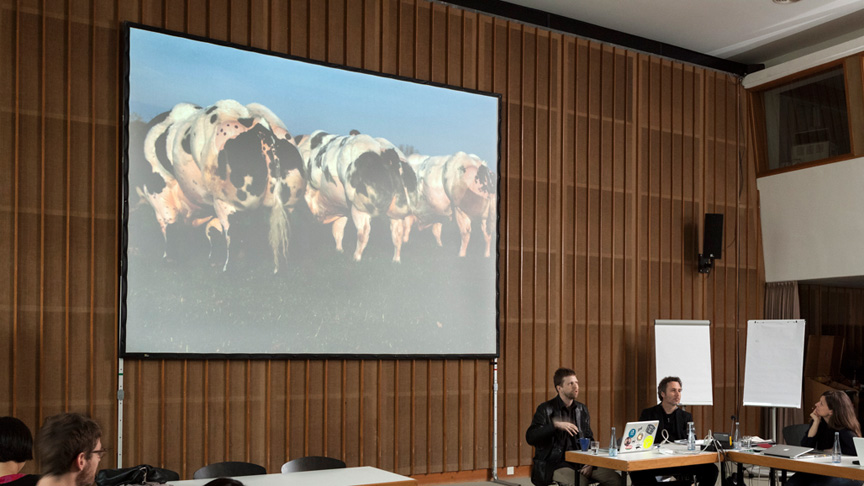
Synapse Workshop 2013 | Presentation by Rich Pell, Center for PostNatural History | Photo: Dante Busquets /courtesy hkw.de see link below...

Christian de Lutz and Regine Rapp are taking part in the curators' conference and workshop SYNAPSE at Haus der Kulturen der Welt (http://www.hkw.de/en/programm/projekte/2015/synapse_2015/start_synapse.php) from 30 June-4 July, 2015, and are moderating several panels including including one featuring the artist Rachel Mayeri and biologists and philosopher Cord Reichelmann.


SYNAPSE is not not open to the general public but an associated event on 2 July will be: Observations of Predation in Humans: A Lecture by Dr. Zira, Animal Psychologist a Performance by Coco Fusco  

Monday, June 29, 2015

Plan Bienen - A project by Tessa Zettel and Sumugan Sivanesan

26-28 June, 2015 - Plan Bienen
A project by Tessa Zettel and Sumugan Sivanesan
Opening: 26 June from 8PM
Brunch and Talk: 28 June 12-2PM
Viewing open 27-28 June, 2015 from 2-6 PM


Plan Bienen is an ongoing research project developed by Sydney-based artists Tessa Zettel and Sumugan Sivanesan during their residency at ZK/U - Centre for Art and Urbanistics in Berlin in 2014.
With Plan Bienen the artists attempt to make real and speculative connections between two parallel crises – one within European economic systems and the other in honeybee ecologies. Considering Berlin’s development as a multicultural ‘creative’ capital, the artists take the local histories and current popularity of urban beekeeping as an entry point to explore expanded possibilities for non-monetary economies and new social habits already present within Berlin’s food systems, intercultural gardens, migrant networks and ‘hausprojekts’. In the process they ask what kinds of promising ‘more-than-human’ futures might today’s city bees lead us towards.

‘Plan Bienen: Statements of Profit and Loss,’ will be open Friday evening, as well as Saturday and Sunday from 2-6PM, and will show documents and artefacts generated by the project. On Sunday 28 June there will also be a brunch and conversation, 'Rates of Exchange—A Discursive Sonntagsbrunch', discussing exchange and relations in the multispecies city, from 12-2PM.

*                                                    *                                                    *

Tessa Zettel
is an interdisciplinary artist who works to create possible futures from forgotten pasts. Her participatory, site-based projects often involve forms of exchange and new relationships with obscured cultural practices and knowledge.

As an ‘anti-disciplinary’ artist, Sumugan Sivanesan works with a multiplicity of media. His installations, performances, videos and texts present a space for discussion and intervention.
Cooperation Partners: ZKU - Centre for Art and Urbanistics, Berlin Food Art Week
This project is supported by the Australian Artists' Grant. The Australian Artists’ Grant is a NAVA initiative, made possible through the generous sponsorship of Mrs Janet Holmes à Court and the support of the Visual Arts Board, Australia Council for the Arts

Photos by Tim Deussen
©2015


Friday, April 24, 2015

Opening - bOdy pandemOnium. Immersion into Noise - works by Joseph Nechvatal

Christian de Lutz and Joseph Nechvatal

Joseph Nechvatal, Viral Venture, 2009


Joseph Nechvatal, rear windOw curiOsite´s (2012)


Joseph Nechvatal, frOnt windOw retinal autOmata>

Tuesday, April 21, 2015

bOdy pandemOnium
Immersion into Noise
works by Joseph Nechvatal

Opening: 24 April 2015, 8PM
Artist Talk & Noise Music Concert: 25 April, 2PM
Exhibition runs: 25 April – 21 June 2015
Opening hours: Fri-Sun, 2-6PM and by appointment
J. Nechvatal, frOnt windOw retinal autOmata, 2012,
Computer-Roboter gesteuertes Gemälde, 2x2m


Joseph Nechvatal (born in 1951 in Chicago) is a post-conceptual artist working in digital art. He is one of the most important pioneers of 'new media art,' but at the same time makes use of 'old media' (such as painting and drawing). What is phenomenal, and in our opinion relevant to the 21st century, is that his paintings are created through a use of custom artificial life software and computer robotics.

The exhibition, subtitled Immersion into Noise, is Nechvatal’s first solo show in Berlin and presents recent works to a Berlin audience alongside his eponymous book Immersion into Noise (2011). In that text, Nechvatal provides visual analogies to audio noise within the powerful effects of the act of immersion.

In the bOdy pandemOnium exhibition, and in Nechvatal's work in general, the term viractualism, meaning the interface between the biological and the technological, plays an essential role: "The basis of the viractual conception is that virtual producing computer technology has become a noteworthy means for making and understanding contemporary art. This brings art to a place where one finds the merging of the computed (the virtual) with the uncomputed corporeal (the actual)."

Parallel to his theoretical research, Nechvatal has created a series of paintings and projections that show a C++ custom virus program (created with the programmer Stephane Sikora) invading, destroying and transforming his painterly art images based on intimate parts of the human body. In the exhibition at Art Laboratory Berlin, two large computer-robotic assisted paintings will be on display: frOnt windOw retinal autOmata (2012) and rear windOw curiOsites (2012).

Also on view will be one of his famous viral computer software de-generative works: Viral Venture (2011). It is accompanied by a musical score for two hundred electric guitars by the com-poser Rhys Chatham.

An artist talk with noise music concert of his piece 3 pOstmOrtems will take place on the opening weekend, on Saturday, 25 April, 2pm.

Curators: Regine Rapp & Christian de Lutz