Wednesday, January 29, 2014

Presentation by Rüdiger Trojok

25 January, 2014


Rüdiger Trojok studied systems and synthetic biology at the University of Potsdam and the University of Freiburg in Germany and Denmark Technical University. Currently he is building up a citizen science biolab in Berlin and actively promoting open source biotechnology in public, politics and the arts

Saturday, January 25, 2014

DIY Bio Lounge - Biohackathon

25 January, 2014
2-6 PM DIY Bio Lounge; bio-hackathon


A full day programme of events introduced and led by biologist Rüdiger Trojok, combining science art, and open source science technology. This event is part of a larger project to create an open bio lab project in Berlin (see http://www.openbioprojects.net/ for more information.)

Art & Science Dialog with Theresa Schubert and Andy Adamatzky

24 January, 2014, 8 PM: Art & Science Dialog with Theresa Schubert and Andy Adamatzky
In a dialogue between artist and scientist, Theresa Schubert and Andrew Adamatzky discuss working with the single cell organism Physarum polycephalum. As a living curiosum, this type of slime mould serves as a model for network optimisation. It can be interpreted as an 'agent' who distributively solves geometric problems. Presenting artworks and results of experiments, the talk challenges common understandings of intelligence and creativity, and emphasises a post-human view on the world and its creatures.


Theresa Schubert (l), Andy Adamatzky (r)
presentation: bio-computing with slime mould (Physarum)


Sonification of slime mould computing
Theresa Schubert's presentation
Slime mould computing most efficient path in a labyrinth


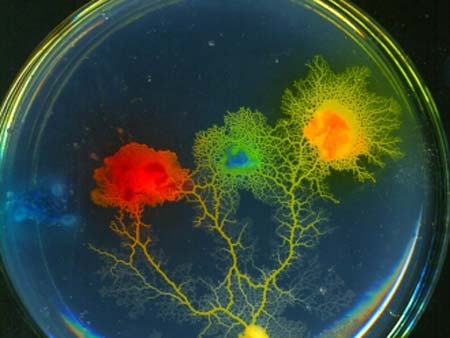
The Physarum is a large single cell visible by unaided eye. When colonizing space the Physarum moves towards attractants and stays away from repellents. Thus the slime mould forms an optimal network of protoplasmic tubes to transfer nutrients and metabolites. When  configurations of attractants and repellents are thought of as instantiations of mathematical problems the protoplasmic network developed  by slime mould  represents a solution.  Through impromptu experiments, analysis of artworks and research findings, Theresa and Andy will address meaning of primordial  creativity with emphasize on a emergence of post-humanism.

Friday, January 24, 2014

The Food Question - a Bioluminescent installation by Jessica Bernds and Sarah Chareza

Accompanying Art Laboratory's programme of events (DIY Bio Lounge), this installation displays the bioluminescent bacteria (Aliivibrio fischeri). These bacteria are widespread in all oceans, and prefer to live in symbiosis with marine organisms. Bioluminescence, chemical reactions within the bacterial cells, make these cells visible in the dark. 

The Aesthetics of Decay 

We find the process of decay in organic matter during almost every moment of our lives. Food spoils, flowers wither, living things die. Foods that have intentionally been left to decay, so as to drive up prices, are an expression of a capitalised world whose excesses are an extreme caricature of man's claim to be a social being. However, decay sometimes involves a unique aesthetic - when organic matter decomposes it often leads to a phenomenon - phosphorescence - which appears as a magical glow. Whoever has walked in the twilight through an intact forest, may have encountered this greenish shimmer, and can understand how early cultures, with their own "knowledge", believed in gates to another world.

Another naturally luminous phenomenon is bioluminescence. In contrast to phosphorescence it is produced by living organisms - bacteria. Aliivibrio fischeri, the official name of these bacteria, usually live in symbiosis with marine organisms. To isolate it from other organisms provides a bridge between decomposition and survival. A popular and simple experiment is to place a fresh (green) herring in a 3% salt solution in a refrigerator for about 3 days. After this time, small, dark, turquoise glowing spots show up on the skin of the fish - Aliiibrio fischeri . Another possibility, which was also used for this installation, is the isolation of Aliivibrio fischeri from squid. For this, the ink bladder, and possibly a portion of the intestines, are used as a nutrient medium. After two to three days glowing bacteria can be transferred onto culture medium in order to be further isolated.

By providing the decay of food as a prerequisite for obtaining the life forms, which are also the art medium here titled "Food Question", we would like to draw attention to real, existing, but currently (still) unnecessary food shortages. Future generations will need to access new resources to sustainably feed a growing world population. All people on the planet can still have access to sufficient available food, but we can no longer close our eyes to millions of tonnes of grains which are deliberately left to decay in order to artificially drive up prices. Food is a basic need for all living beings, not something to be speculated on for maximum profits!

(text by the artists ) 
Jessica Bernds holds a Diploma in Biology and is a "free time artist". She got introduced to the DIY Biology movement in 2012 and is now part of the evolving and growing Berling DIY Bio group. Her interests are set between science and art. Focusing on the scientific part she likes using arts to introduce the scientific facts to a larger audience.

Sarah Chareza completed her PhD in Microbiology and Virology at the Germany Cancer Research Center in Heidelberg and is currently working in a contract research organisation.

Wednesday, January 22, 2014

DIY Bio Lounge // 24 - 26 January, 2014


24 January, 2014, 8 PM: Art & Science Dialog with Theresa Schubert and Andy Adamatzky
In a dialogue between artist and scientist, Theresa Schubert and Andrew Adamatzky discuss working with the single cell organism Physarum polycephalum. As a living curiosum, this type of slime mould serves as a model for network optimisation. It can be interpreted as an 'agent' who distributively solves geometric problems. Presenting artworks and results of experiments, the talk challenges common understandings of intelligence and creativity, and emphasises a post-human view on the world and its creatures.
Theresa Schubert (DE) is a post-media artist, works as an artistic researcher and is a PhD candidate at the Bauhaus-University Weimar. (http://www.theresaschubert.org/)
Andrew Adamatzky (UK) is Professor in Unconventional Computing in the Department of Computer Science, Director of the Unconventional Computing Centre, and a member of Bristol Robotics Lab at the University of the West of England.
(http://uncomp.uwe.ac.uk/adamatzky/)


25 January, 2014
2-6 PM DIY Bio Lounge; bio-hackathon
7 PM Presentation by Rüdiger Trojok
6 PM - open end: DIY Bio Lounge, drop in & drop out; open bio lab; molecular cocktails; Bioluminescence installation by Sarah Chareza and Jessica Bernds

A full day programme of events introduced and led by biologist Rüdiger Trojok, combining science art, and open source science technology. This event is part of a larger project to create an open bio lab project in Berlin (see http://www.openbioprojects.net/ for more information.)
In the evening there will be a Molecular cocktail bar, serving sparkling wine with aperol bubbles, as well as 'smoking' cocktails.


26 January, 2014
2-6 PM DIY Bio Lounge, open bio lab
3 PM: BioStrike: Open Antibiotics Discovery a presentation by Denisa Kera (hackteria.org and National University of Singapore)


25-26 January, 2014
Bioluminescence an installation by Sarah Chareza and Jessica Bernds
Accompanying Art Laboratory's programme of events (DIY Bio Lounge), this installation displays the bioluminescent bacteria (Aliivibrio fischeri). These bacteria are widespread in all oceans, and prefer to live in symbiosis with marine organisms (e.g. herring or squid). Bioluminescence, chemical reactions within the bacterial cells, make these cells visible in the dark. In contrast to phosphorescence, which is observed in decomposing organic material and can only be made visible through the absorption of outside light, bioluminescence only occurs in living organisms.

In the installation, these harmless bacteria have been cultivated on a nutrient medium. The artists aim to represent the aesthetics of decay, the daily occurrence when a large number of unused food wastes away, and thereby make a statement about the "the Food Question" and its relation to the global food shortage.


Jessica Bernds is a Berlin based biologist and bio-artist.

Sarah Chareza completed her PhD in Microbiology and Virology at the Germany Cancer Research Center in Heidelberg and is currently working in a contract research organisation.
Denisa Kera is a philosopher and a designer, who uses prototypes to rethink history of science, but also future scenarios related to emerging technologies. In 2013 she became a collector of DIYbio prototypes and Hackteria network archivist. She is also Assistant Professor at the National University of Singapore.
Rüdiger Trojok studied systems and synthetic biology at the University of Potsdam and the University of Freiburg in Germany and Denmark Technical University. Currently he is building up a citizen science biolab in Berlin and actively promoting open source biotechnology in public, politics and the arts.

DIY Bio Lounge is a project in cooperation with openbioprojects.net and the Vorspiel 2014 programme of transmediale and CTM.

Media partner:


image: Differential intake of coloured substances by slime mould Physarum polycephalum in laboratory implementation of Kolmogorov-Uspenskii machine. Courtesy of Andrew Adamatzky. Adamatzky A. "Physarum Machines" (World Scientific, 2010).

Friday, November 01, 2013

Viewing and Artist Talk
Nasim Manouchehrabadi: The Power of Form, the Form of Power
25 - 27 October 2013


The Tehran-born and Berlin-based artist and designer Nasim Manouchehrabadi presented her work The Power of Form, The Form of Power at Art Laboratory Berlin from 25-27 October 2013. The work The Power of Form, The Form of Power brings together, in the sublimated form of a carpet, cultural, social and political aspects of life in Iran and shows the contrast between tradition and modernity in Iranian society. The examination of ornamental geometric forms, the political protests against the Islamic regime in 2009, and social conflicts in modern society all serve as the starting points for artistic engagement.

Curated by Olga Shmakova


Friday, October 04, 2013

Artist Talk with Pinar Yoldas- 3 October, 2013


Pinar Yoldas is a cross-disciplinary artist and researcher with a background in architecture, interface design, computing and neuroscience. Her work investigates social and cultural systems in regards to biological and ecological systems. She is the 2013/14 resident at the Vilém Flusser Residency Programme for Artistic Research, run by transmediale and the Berlin University of the Arts (UdK).

Pinar has a Master of Fine Arts degree from University of California Los Angeles. Currently she is a PhD candidate in Visual and Media Studies program at Duke University, where she's pursuing a certificate in the Center for Cognitive Neuroscience. She has been awarded fellowships in art and science venues including the MacDowell Colony, UCross Foundation, VCCA and National Evolutionary Synthesis Center.

Her current project An Ecosystem of Excess is an attempt to create a post-human eco-system, a living community of speculative organisms and their environment. The project takes the idea that we are surrounded by "man-made extreme environments" as its starting point. A man-made extreme environment is a site of excess, where leftovers of our capitalistic desires and consumerist actions are accumulated. Hence junkyards, landfills, wastelands are all examples of "man-made extreme environments'. An Ecosystem of Excess starts in the Pacific Trash Vortex. Discovered in 1985 by Captain Roger Marshall, this site is a floating nexus of plastic waste covering roughly 5000 km² area of the Pacific. Pacific Trash Vortex is a monument of plastic waste at a global scale.

http://www.transmediale.de/content/project-description-an-ecosystem-of-excess
http://pinaryoldas.info/speculativeBiologies/

http://www.endangeredspecies.be

in cooperation with transmediale

Tuesday, October 01, 2013

Speculative Biology Workshop with Pinar Yoldas on 28 September 2013

Photographs from Speculative Biology Workshop: The Design of Biological Systems and Neo-organs with Pinar Yoldas


In her workshop the artist gave a quick overview into general biological systems such as the circulatory system, the respiratory system, the nervous system, the reproductive system etc., and how these systems might evolve under the influence of global environmental transformations.

Somewhere between bio-mimicry and critical design, the workshop will gave particpants the time and assets to discuss and design speculative models for life forms for a post-human era.