Wednesday, April 25, 2012

Our ongoing exhibition Fantastic Time Machines continues through Sunday 29 April:

Time Sifter by Shlomit Lehavi is an interactive video installation which explores collective memory, collective forgetting and the relationship between mankind and technology. By means of touching the changing projections in the work the visitor creates her own narrative through the act of participation.

The other work in the exhibition, The Reversing Machine (A Theatre of Kairos and Chronos) makes use of a machine with a reversing gear box to create a mechanical palindrome, which in turn questions our sense and definition of time. The work alludes to the opposition of Kairos, the notion of opportune time to Chronos, the course of time. The Reversing Machine will remain in the gallery after the exhibition closes and can be seen until 12 May during the performances mentioned below
.


Fantastic Time Machines until 29 April, 2012, Thu-Sun 2-6PM, Fri 27 April until 10PM (and by appointment)
(More information at http://artlaboratory-berlin.org/html/eng-exh-archive.htm)


May Performances in conjunction with the Month of Performance Art

Sunday, 6  May, 2012  1PM

Is the Desert Still the Desert in a Digital World? by Gretta Louw (Performance)


Gretta Louw, whose performance and exhibition Controlling Connectivity started off the current Time & Technology series will set up a live video link up between Art Laboratory Berlin and the Warnayaka Arts centre in Lajamanu, Australia, located in the remote central Australian desert.

Since March Louw has been taking part in a residency in Lajamanu teaching photography, video and new media to  indigenous arts workers, as well as introducing them to online communication platforms. The culmination of this first program of new media training will be a real time link-up between Lajamanu and Berlin.

A live audience in Berlin will view a simultaneous performance streamed out of Lajamanu, captured by a number of webcams and presented as two large-format projections. The event will incorporate an eclectic and innovative mix of traditional dance and storytelling, as well as live VJing of documentation organised by Louw. The event will also provide and encourage the possibility of interaction and exchange between participants in both Berlin and Lajamanu. (More information at http://artlaboratory-berlin.org/html/eng-event-14.htm)

In cooperation with the Warnayaka Art Centre


Thursday, 10 May, 2012   8PM (Performance)


Palindromes: Musical Transpositions for the Reversing Machine (Performance)


Works by Cage and others adapted for the output of the Reversing Machine plus new sound works by Sam Belinfante & Simon Lewandowski. In conjunction with the exhibition Fantastic Time Machines and our current series Time & Technology. Belinfante & Lewandowski will perform a series of sound works and actions using the Reversing Machine mechanism and attached devices. (More information at http://artlaboratory-berlin.org/html/eng-events-archive.htm)


Saturday May 12, 2012  4PM

Subjective Time: Dreams, Drones, Flickers and Alpha Rhythms (Workshop)

Workshop with the artists Sam Belinfante & Simon Lewandowski: Talks, presentations and experiments with the Reversing Machine. The artists will offer the public a more intimate experience with their installation, including as series of additional actions and interactions, explanation as an queries into the nature of time and perception. (More information http://artlaboratory-berlin.org/html/eng-events-archive.htm)


Cooperation Partner: Month of Performance Art Berlin


Special Thanks to Hauptstadtkulturfonds and the Israeli Embassy in Berlin for supporting Fantastic Time Machines and Michael Schröder for his support of Time & Technology

Tuesday, April 03, 2012

Artist talk with Shlomit Lehavi 30 March, 2012

The Israeli born and New York based artist Shlomit Lehavi presents her video installation Time Sifter as a part of the exhibition Fantastic Time Machines. Shlomit Lehavi works primarily with new media and multi-channel video. Time Sifter explores collective memory, collective forgetting and time based media as a contemporary time machine. By means of touching the changing projections in her work the visitor is allowed a fascinating form of participation and interaction.


photos courtesy Art Laboratory Berlin, copyright 2012

Fantastic Time Machines is supported by the German Capital Culture Funds and the Israeli Embassy in Germany.

Friday, March 23, 2012

Time & Technology
Fantastic Time Machines

Shlomit Lehavi
Sam Belinfante & Simon Lewandowski


Opening: 23 March, 2012, 8PM
Artist talk with Shlomit Lehavi: 30 April, 2012, 8PM
Exhibition runs 24 March - 29 April, 2012
Opening Hours: Thu - Sun, 2-6PM, closed on 8 March


The Reversing Machine (A Theatre of Kairos and Chronos) by Sam Belinfante & Simon Lewandowski


Time Sifter by Shlomit Lehavi


Photos © 2012 by Tim Deussen/fotoscout.de

As part of the current exhibition series Time & Technology Art Laboratory Berlin welcomes you to the exhibition Fantastic Time Machines with new works by Shlomit Lehavi and Sam Belinfante & Simon Lewandowski. The two contributions deal with the phenomenon of time through synchronicity, simultaneity and succession. These artists have developed special forms of imaginary time machine.

In the front room the viewer finds The Reversing Machine (A Theatre of Kairos and Chronos), produced by the British artists Sam Belinfante and Simon Lewandowski especially for this exhibition. The installation alludes to the notion of Kairos as opportune time, as opposed to Chronos, the course of time. The artwork is a constructed mechanism, whose central piece, called by the artists a Time-Setter or Chronocrator, is an attempt to examine temporal perception by means of running different machines forwards and backwards. Both its analogue structure and its emphasis on bi-directionality (dual-direction) call modern conceptions of linear progress into question.

This palindrome is an artistic reflection on our contemporary life with its many simultaneously controlled processes and repetitive actions. “The central device (literally and figuratively comprising the functioning core) is a kinetic sculpture in the form of a self-reversing gearbox mechanism which will trigger and power various (forward and reverse) looping devices.” The drive shaft powers a series of machines (a turntable, a slide projector, moving lamp, etc.) – and then switches in reverse, forming a mechanical palindrome which in turn creates a poetics of dichotomy: on and off, forward and reverse, loud and quiet, dark and light.

“This behaviour is entirely determined by the mechanism, (not by any kind of digital controller) being consequently completely transparent – revealing both the what and the how of its action.” (Belinfante & Lewandowski)

In the back room Art Laboratory Berlin presents the work Time Sifter by the Israeli born and New York based artist Shlomit Lehavi who works primarily with new media and multi-channel video. Her video installation Time Sifter explores collective memory, collective forgetting and time based media as a contemporary time machine.

"Time Sifter is a viewer-controlled environment immersed in visuals and sounds” says Lehavi, “that plays on the theme of the time-machine in the digital age, and suggests a journey in time through motion, space and sound.” The projection surface, which resembles a totem pole, is a shaped steel construction with circular wooden sieves, hand-crafted in Istanbul and retrofitted with projection material. It represents both the mechanism and the metaphor of sifting time.

The video footage, taken by the artist, depicts movement through space at different locations over the last ten years. This repetition of similar actions – travel, work, the role of the flaneur - in different places creates a series of links over time and space.

The visitor in turn plays a crucial role in the functioning of this time machine: "Each sieve flips around the x-axis (initiated by the viewer). With each flip the video's content changes so the viewer has control over re-creating the environment, the video sequences and the narrative. Time Sifter aims to evoke a discussion on time and space in the digital age." (Shlomit Lehavi)

Curated by Regine Rapp and Christian de Lutz

Fantastic Time Machines is supported by the German Capital Culture Funds and the Israeli Embassy in Germany.

Wednesday, March 21, 2012

Time & Technology
Fantastic Time Machines

Shlomit Lehavi
Sam Belinfante & Simon Lewandowski

Opening: 23 March, 2012, 8PM
Exhibition runs 24 March - 29 April, 2012
Opening Hours: Thu - Sun, 2-6PM, closed on 8 March

As part of the current exhibition series Time & Technology Art Laboratory Berlin shows the exhibition Fantastic Time Machines with new works by Shlomit Lehavi and Sam Belinfante & Simon Lewandowski. The two artistic contributions deal with the phenomenon of time through synchronicity, simultaneity and succession. These artists have developed special forms of imaginary time machines.


Shlomit Lehavi's Time Sifter


Detail from Belinfante and Lewandowski's Reversing Machine


Photos by Shlomit Lehavi

The British artists Sam Belinfante and Simon Lewandowski present the newly produced work The Reversing Machine (A Theatre of Kairos and Chronos) which alludes to the notion of Kairos as opportune time, as opposed to Chronos, the course of time. The artwork is a constructed mechanism, which the artists call a Time-Setter or Chronocrator and which tries to examine temporal perception by means of running different machines forwards and backwards. This mechanical palindrome is an outstanding artistic reflection on our contemporary life with its many simultaneously controlled processes and repetitive actions.

Israeli born and New York based Shlomit Lehavi is an installation artist specialising in the relationship between technology and mankind. She examines the theme of memory and its relationship to technology. Her video installation Time Sifter explores collective memory, collective forgetting and the role of individuals. By means of touching the changing projections in her work the visitor is allowed a fascinating form of participation and interaction.

Curated by Regine Rapp and Christian de Lutz


With the generous support of:

Media Partner:


Cooperation Partners:

University of Leeds, http://www.leeds.ac.uk/

The Wild Pansy Press, http://www.wildpansypress.com

PSL (Project Space Leeds) http://www.projectspaceleeds.org.uk/

ITP, Tisch School of the Arts, NYU, http://itp.nyu.edu/itp/

Effects Too, http://www.effectstoo.co.uk/

The Time & Technology series is made possible in part by a generous gift from Michael Schröder.

Wednesday, March 14, 2012

Time & Technology

plan b (Sophia New & Daniel Belasco Rogers) Navigating the Everyday

28 January - 11 March, 2012

Navigating the Everyday presents works by plan b, the British artist duo Daniel Belasco Rogers and Sophia New, and is their first solo exhibition in Germany. Since 2003 and 2007 respectively, Daniel and Sophia have been recording every journey they make every day using GPS devices. Additionally all areas of their digital communication (e.g. mobile phone text messages) are evaluated and processed artistically. Their work represents an artistic research by means of a digital archiving of their movements.

Over the years this practice has become part of everyday life, a form of private and personal 'sousveillance', in which the artists generate their own data, thereby reflecting the approach of those private and public agencies who collect all available data.
(More information)


Photos by plan b

Monday, February 27, 2012

plan b

Navigating the Everyday

From the tour through he exhibition with the artists on
24 February, 2012. The exhibition runs through 11 March.


photos by Olga Shmakova, courtesy Art Laboratory Berlin

Time & Technology
plan b (Sophia New & Daniel Belasco Rogers)
Navigating the Everyday

Exhibition runs from 28 January - 11 March, 2012
Opening Hours: Fr - Su, 2-6PM

Wednesday, February 22, 2012

plan b

Navigating the Everyday

Tour through he exhibition with the artists: 24 February, 2012 7.30PM
Exhibition runs: 28 January – 11. March, 2012
opening hours: Fr – So, 2-6PM
, on 24 February until 10.30PM!


On Friday 24 February, 2012 the exhibition 'Navigating the Everyday' will be open until 10.30PM. At 7.30PM there will be a tour through the exhibition with the artists Sophia new and Daniel Belasco Rogers (plan b).

Navigating the Everyday
presents works by plan b, the British artist duo Daniel Belasco Rogers and Sophia New, and is their first solo exhibition in Germany. Since 2003 and 2007 respectively, Daniel and Sophia have been recording every journey they make every day using GPS devices. Additionally all areas of their digital communication (e.g. mobile phone text messages) are evaluated and processed artistically. Their work represents an artistic research by means of a digital archiving of their movements.Over the years this practice has become part of everyday life, a form of private and personal ‘sousveillance’, in which the artists generate their own data, thereby reflecting the approach of those private and public agencies who collect all available data.

Since January 2011, the artists have also recorded their moods in writing three times a day. This mood diary enables them to compare their emotional life with the GPS traces of their movements and collected text messages. Presentation of the act of remembrance, in human and machine form, provides material for the two-channel video installation Narrating Our Lines , shown here in full for the first time. The video installation shows the artists viewing an animation of the GPS traces of their movements from 2007.
More information at: http://artlaboratory-berlin.org/html/eng-exh-archive.htm

Curated by Regine Rapp and Christian de Lutz

Monday, February 20, 2012

Fresh from the Printers!

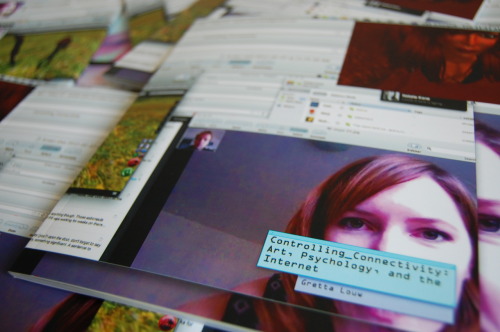
Controlling_Connectivity: Art, Psychology, and the Internet by Gretta Louw

Friday, February 03, 2012

plan b ' Navigating the Everyday'

28 January - 11 March, 2012


Navigating the Everyday presents works by plan b, the British artist duo Daniel Belasco Rogers and Sophia New, and is their first solo exhibition in Germany. Since 2003 and 2007 respectively, Daniel and Sophia have been recording every journey they make every day using GPS devices. Additionally all areas of their digital communication (e.g. mobile phone text messages) are evaluated and processed artistically. Their work represents an artistic research by means of a digital archiving of their movements.

Over the years this practice has become part of everyday life, a form of private and personal 'sousveillance', in which the artists generate their own data, thereby reflecting the approach of those private and public agencies who collect all available data.

Since January 2011, the artists have also recorded their moods in writing three times a day. This mood diary enables them to compare their emotional life with the GPS traces of their movements and collected text messages. Presentation of the act of remembrance, in human and machine form, provides material for the two-channel video installation Narrating Our Lines, shown here in full for the first time. The video installation shows the artists viewing an animation of the GPS traces of their movements from 2007. With a temporal distance of three years, they then recall past events of their lives through these traces. On one screen, the viewer can see the artists, while on the other we see what the artists see - the GPS traces of their movement. A striking tension is achieved, while they (re)construct the common narrative of their lives.

In addition to this installation, additional objects are presented, which have resulted from their practice of collecting: an archive of their mobile text messages, lists of personal vocabulary based on the frequency of use, as well as journals of their fluctuating moods arranged by season, time of day and location of each of the artists.

Curated by Regine Rapp and Christian de Lutz.

Special thanks to Peter Vasil.

In cooperation with the Transmediale, Mixed Reality Lab and University of Nottingham

With the generous support of Michael Schröder

Sponsored by Shortcut